
White paper · The Evolution of Selling
Solution Sales Isn’t Dead. It’s Just Not Enough.
Seller skill no longer wins major deals on its own.
Get the full paperExecutive summary
In IT services, seller skill is no longer enough to win major deals. The binding constraint is whether management can see and steer the client’s decision while it is still being formed. Most firms cannot.
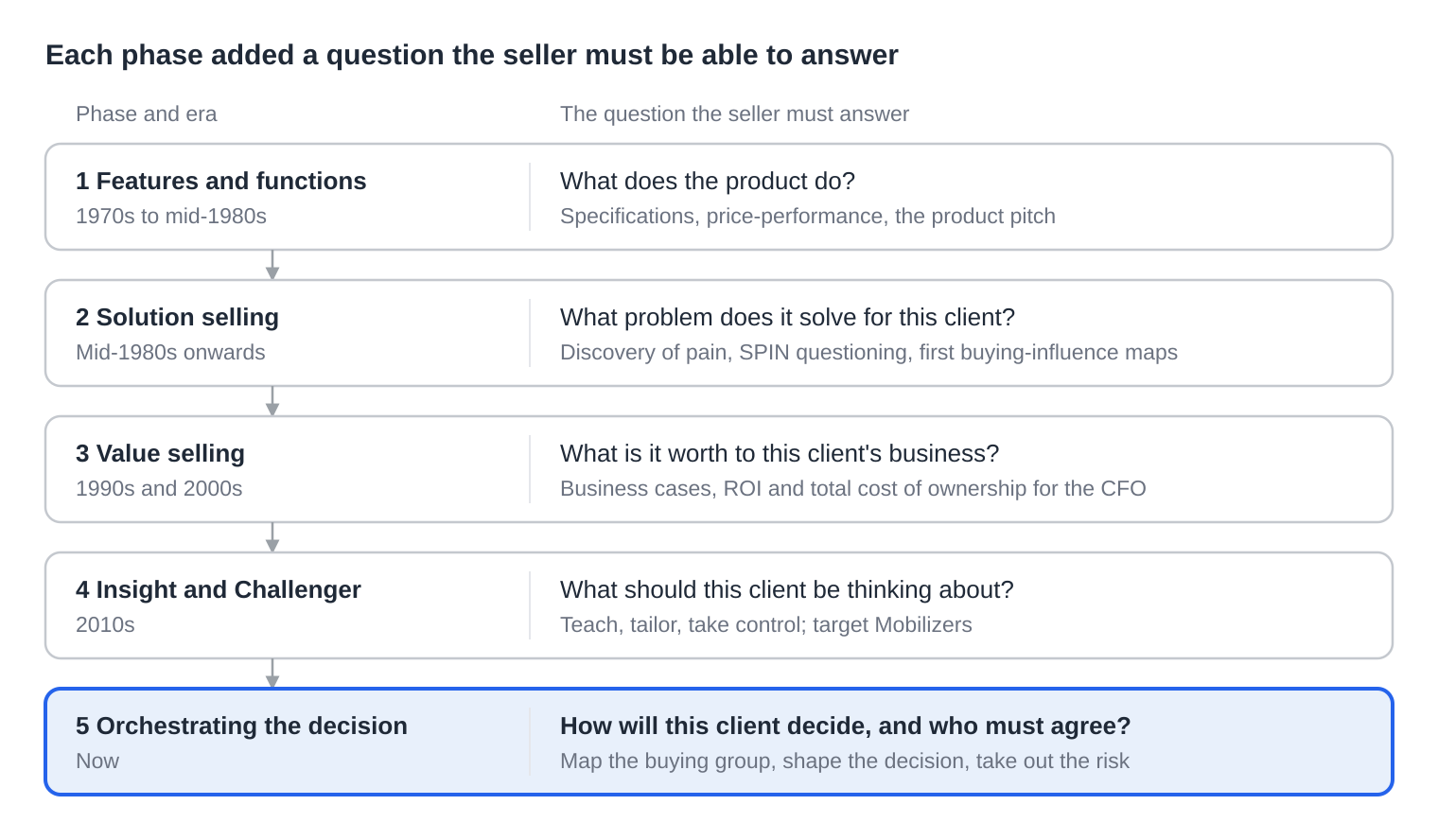
Fifty years of method have each added a question the seller must be able to answer, from “what does our product do?” to “how will this client decide, and who must agree?” The skills are well documented and widely trained. Yet buyers now do most of the work without suppliers, increasingly with AI, and often with a hyperscaler or sourcing adviser shaping the decision first. Deals are lost less to competitors than to indecision, and AI is changing the size and the pricing of the deals themselves.
None of that is fixed by training alone. It is fixed by how leaders steer their major deals: choosing early which deals to shape, reviewing them at a few decisive moments, and judging progress by what the client has done rather than what the seller has said.
Fifty years in five questions
Each era of selling added a question without retiring the previous one. What changed each time was where the decisive conversation took place.
Six questions for sales leaders
Answer them for your ten largest open deals and your five largest renewals.
| Question | What good looks like | Warning sign |
|---|---|---|
| Did we know about this deal before the client wrote its requirements? | Most major deals were known and influenced early | You first heard of it when the RFP arrived |
| Who on the client side is driving this decision, and what have they done this month? | A named Mobilizer, with evidence of action: meetings convened, information shared | A friendly contact who “will put in a good word” |
| Does our deal review record what the client has done, or only the stage we assigned? | Client actions are the evidence for each stage | Stage, value and close date only |
| How many deals did we decide not to pursue this year, and why? | A deliberate number, with reasons recorded | None: everything gets bid |
| For our top renewals, have we treated the client as starting a new decision? | The rebid is run like a new major deal, well before notice periods | The renewal is left to contract administration |
| Where a hyperscaler or sourcing adviser is involved, are they on our map? | Mapped, with someone accountable for each | Discovered at the shortlist stage |
More than two warning signs suggest the constraint is not seller skill alone. It is how the organisation decides where and when to compete.
Read the full paper
Six pages, with sources. Beyond this summary, it covers:
- Why each sales method of the last fifty years stopped working, from the product pitch to the Challenger Sale
- Five shifts that are new in 2026: AI-assisted buyers, self-service, the hyperscaler and adviser ecosystem, sovereignty, and AI-driven deal pricing
- Why indecision, not competition, loses most deals, and what management can do about it
- Four habits of firms that steer their major deals well
Thank you
Your download should start automatically. If it doesn’t:
Download the PDFQuestions or a different view? I’d like to hear it: jan.cleeren@sanremo-group.com